Showing posts with label 05 States of Consciousness. Show all posts

Wednesday, March 28, 2012

The Scientific American Day in the Life of Your Brain


I was going through my books today and rediscovered a wonderful reference for class.  It's called The Scientific American Day in the Life of Your Brain.  It takes a person from 5 am and waking up, what brain chemicals are activating us and other sensory issues.  It goes on to deal with coming to consciousness, morning emotions, directions to work, facing others, performance at work/stress, decision making, the hungry brain, the tired brain, boredom, pain, exercise, the dimming of the day, getting home from work, music, humor, love and lust, getting to sleep, falling to sleep, sleeping and problems, and people who have to work at night.  The book is at a reading level appropriate for those of use brushing up on brain science as well as high school students.

In short, take any person on any day and the book will have a section on what is happening in a person's brain.  I can imagine a creative teacher, with proper resources, making this a class assignment--what is going on with the brain and rest of the biology of humans during each part of the day, and dividing it up like the chapters/sections of this book.  If you do that, just keep this book hidden ;)


posted by Chuck Schallhorn

Tuesday, December 13, 2011

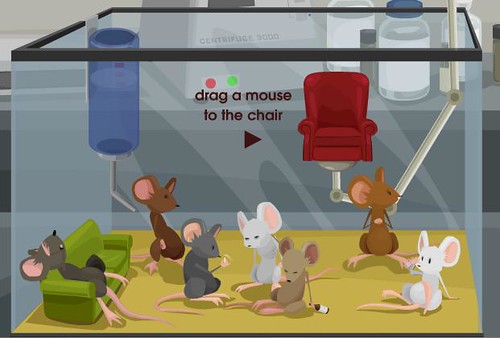
More than Mouse Party

It's not that Mouse Party isn't one of the most amazing websites for teaching about how various drugs affect neural tranmission - CAUSE IT IS - but there's a lot more to this site than just Mouse Party. Check out some other offerings from the Genetic Science Learning Center at the University of Utah:

Oh - did I mention the lesson plans and activities? Oh my!

So - how do you use Mouse Party and these other sites in your class? Have you played Cerebral Commando or used any of these other links? Please share below!

P.S. I could listen to the Mouse Party music all day. Is that wrong?
-- posted by Steve

Saturday, July 30, 2011

New Society for Neuroscience Website--

The Society for Neuroscience has created a wonderful resource that could potentially be utilized by those of us who can get our kids to the internet or for use during snow days or other cancellations.  It could also be used in a webquest.  Wonderful name as well:  "NERVE: Virtual Encycloportal."  I do believe they have engaged in creating a new word, a neologism. 

After the welcome page, the user is directed to this page where there are links to various themes including addiction, anatomy of the brain, and much more as you can see from the graphic on the left.

Each theme has numerous links to other resources that provide an incredible wealth of information and graphical representation of each topic.  One could literally spend days examining all the sites.

In fact, I will be starting my background research for my neuroscience, mental health, and sensation and perception units from this page.  There are just so many incredible resources. 

Do take the time to visit the site and search through the topics. 


Core Concepts in Neuroscience is a booklet that is downloadable for teachers and students to use.  Not only is there the booklet, but there is a short PowerPoint that you can download.

posted by Chuck Schallhorn

Friday, July 22, 2011

Neuroscientist David Eagleman on Colbert Report on 7/21/11

I was catching up on some television watching when I discovered this little nugget.  Dr. David Eagleman has written the book, Incognito: The Secret Lives of the Brain which examines the various processes that occur without the conscious mind being aware.  The reviews on Amazon are mixed, but for those of us who are not in the neuroscience field, it could be a good read.  In the interview, he comes across as a younger, cool, hip and bright neuroscientist.  He does not come off all like the stereotypical stodgy scientist image.  It's a short, fun interview.  Who knows, it may just make a student interested in the brain.

The Colbert ReportMon - Thurs 11:30pm / 10:30c
David Eagleman
www.colbertnation.com
Colbert Report Full EpisodesPolitical Humor & Satire BlogVideo Archive


posted by Chuck Schallhorn

Monday, June 6, 2011

Teenagers and Sleep

A colleague shared this NPR story with me this morning.  It is a nice overview/background on teens and sleep issues.  The second story is a followup with experts responding to listener questions.


The Other Big Deficit: Many Teens Fall Short On Sleep

Sleep Experts Answer Your Questions On Teens And Shuteye


posted by Chuck Schallhorn

Tuesday, March 22, 2011

Consciousness = complicated!


Its possible that I'm only interested in this because I used to teach philosophy, but the latest "infographic" from the fabulous blog Information is Beautiful fascinates me. It's called "What Is Consciousness?" and I think it does a great job demonstrating how complex the scientific and philosophical positions/theories are about consciousness, and it's a good example of how a web interface can make a VERY complex subject accessible (at least a bit) and engaging. You get to choose a combination of three positions/theories about consciousness and answer a few demographic questions, then you are given a label for your philosophical positions (holler back at me, other "Emergent Dualistic Epiphenomenalistic Cognitivists"!)

I don't pretend to understand my label means or the implications of these different positions/theories, but I thought it was fun (really!) and thought provoking. I wouldn't go this "deep" into consciousness theories in a psych class, but maybe some students would be intrigued by it.

Other sources that help me think more deeply about consciousness: Daniel Dennet's and Douglas R. Hofstadter's thought experiments in The Mind's I (and other places), and Michael Gazzaniga's work on "split-brain" patients (these videos are a MUST use in a psych class, I think).


posted by Rob McEntarffer

Friday, January 14, 2011

TV Alert--Drug Effects on National Geographic-1/16-1/17/2011

This upcoming Sunday and Monday evenings (January 16-17, 2011), The National Geographic Channel is presenting the first of three shows that detail the effects of drugs on the human body.  Check your local listings for details and times.

The first is called "Drugged: High in Marijuana."
The second is called "Drugged: High in Cocaine."
The third is called "Drugged: High on Ecstasy."

Based upon what they have on the website, it appears to be an excellent overview of each drug and its physiological effects.  I suspect there will also be brain and psychological issues examined.  I will be recording these to be sure.

posted by Chuck Schallhorn

Sunday, December 19, 2010

The Power of Silence

Late yesterday afternoon, my neighborhood lost power due to a "winter" storm.  All told, we were without power for about four hours.  For me, it was four hours of bliss.  I went to the mailbox, seeing several neighbors who had come outside to see if they were alone in the powerlessness.  I then walked to the garage, grabbed a couple of fire logs, and built myself a fire.

I was no longer connected to the interwebs; the tv was not working; and there was no hum from the fridge or from the air purifier.  I refused to put on the earphones of my iPod.  I listened to the rain as it got darker and the fog rolled in.  That, in combination with the fire were, to me, priceless--one of those times when my needs were met with some outside event.

You see, I need silence.  I need solitude.  When I was growing up, I had a series of ear infections and ear aches that cost me part of my ability to hear.  I was 75% deaf in one ear, 50% in the other.  I started school one year later than the other kids because of this.  When I was ten, I had surgery to put a little blue tube in each ear drum to release the fluid build up.  I could not swim for a year and had to keep water out of my ears (had to wear earplugs during showers).  The days after the surgery were the most intense pain I've ever felt--I lay on the couch having ear drops used to lessen the pain.  But I could hear things I'd never heard before--the birds, the traffic, the sounds that we all try to put out of our consciousness, but without which we would feel somewhat empty.  This was part of my introduction to silence by choice versus imposed silence.

My students seemingly need noise, distraction, something to grab at their attention, rarely listening to the voices in their heads (the self-talk kind, not the hallucinatory kind).  When I tell them I need silence from time to time, they look at me like I am crazy.  I tell them that time moves differently when there is silence--it goes more slowly and I can do more of what I need to do, including think. 

I did some cursory research on the issue and found not nearly enough to my liking.  There were many items on meditation and prayer and the power of silence in relation to those practices.  There was even a little about American culture and how Americans tend not to like silence--we will fill up silence with words rather than let the silence sit there, lingering.

As I write this, I am reminded of a story Desmond Morris told of an African tribal group where women did not speak for about six months (if I recall correctly) as a method of mourning the loss of a loved one.  They had developed a wealth of signs to communicate, but speaking was forbidden.

I recall a radio interview some years ago with an author who explained that people who cannot handle silence cannot handle the thoughts that are in their own head.  I do not know of research, but that sounds intuitively true.  In our culture, our children are growing up increasingly distracted--I have students who are very uncomfortable just sitting still during or after an exam.  "Can I listen to my iPod. . .please?" are the plaintive cries, especially this past week during finals. I often think to myself, "What are you afraid of with the silence?  Will it hurt you?  Do you not like what you will find in the world without external noise?  Are you afraid of your inner voice?  Are you so addicted to distractions that it hurts to have silence?"  And I wonder on.

What can one do with this topic in class?  I offer some suggestions:
  1. Explain the importance of silence both in terms of culture (social psychology) and in terms of perception--how does time perception change?  You could do a demonstration with students closing their eyes--you will not tell them how long--have them estimate how long--then tell them the actual time.  Discuss implications of this perception change.
  2. Have the students listen to the sounds of the classroom--can they hear the buzz of the lights?  Can they hear traffic (my classroom is at one of the busiest corners in town)?  Can they hear the shuffling of papers, the crinkling of gum or candy wrappers?  Are they aware of how much noise they themselves make each time they move?  Can they hear their own joints creak when they move (maybe that is just for the teachers)?
  3. Find a film clip(s) or use a willing student as a demonstration in a discussion--how to use silence to set people off guard.  How uncomfortable do we get when people just look at us without saying anything?  It's amazing how much of our insecurity we project into situations when we expect someone else to say something.
  4. Ask students for their own examples of when silence has changed their view of an experience or a conversation.
  5. Try watching a film clip or a sporting event without the sound of the announcers or the crowd--how much does sound fill us up emotionally and send us context clues as to how to respond?
  6. Talk with your local sign-language teacher about the role silence plays in the life of a deaf person--how is the world different for them?
  7. Have students write about how their lives would be different if there were no longer sounds in their lives?  
  8. I'm certain there are dozens more ideas--please feel free to add them in the comments section.

All in all, sound and silence is a fascinating set of topics.  During your vacation (or at least time away from school) I wish for you time to sit in quiet and time to reflect on all the good you do in your work with children. 

Some links for further reading--these are highly rated books that deal with the role of silence in our lives.


A paper that discusses how different cultures use silence in the communication process

Can Silence be Eloquent?
The Eight Core Values of the Japanese Businessman: Toward an Understanding of Japanese Management
A book about Japanese business that has a section on the importance of silence

posted by Chuck Schallhorn

Friday, March 12, 2010

Peter Tripp and the Sleep Deprivation Experiment

We've all read about it.  But the British have made a documentary about it. 

Originally in this post, there were two videos linked to view.  However, the user had his/her account terminated.  As of 1/4/2011, this portion of the video is working.


Thursday, March 11, 2010

The Man Who Never Slept (Fatal Familial Insomnia)

The Man Who Never Slept (Fatal Familial Insomnia)

The original posted link was removed due to the user's account being terminated.  On 1/4/2011, I have added a few other links with this topic.


Posted by Chuck Schallhorn

Wednesday, March 10, 2010

Narcolepsy & Cataplexy Videos

Here are some particularly good video finds for narcolepsy and cataplexy.

British Man Who Has Difficulty Staying Awake


Rusty the Narcoleptic Dog


Little Girl with Narcolepsy

Tuesday, March 9, 2010

Narcolepsy & Cataplexy

Within sleep disorders, there are two key ideas, narcolepsy and cataplexy.  Some links below cover the informational aspect of narcolepsy.


Cataplexy is often a co-symptom of narcolepsy causing the person/animal to lose all muscle tone during an emotional time.  A second examination of cataplexy.

On this Stanford page, there are several videos of animals and one child with cataplexy.

In tomorrow's post, I will share more video finds on narcolepsy and cataplexy.

Monday, March 8, 2010

Sleep and Sleep Disorders

When most of us cover States of Consciousness, we might give passing mention to sleep disorders.  As someone who suffers from sleep apnea, I choose to spend a little more time, especially with the condensed time frame teenagers have to sleep--dealing with their enforced insomnia. 

 
Stanley Coren has an excellent book that I've been using for years called, Sleep Thieves.  In the book, there is a 17 question "quiz" about symptoms related to too little sleep.  We go over the results that the book gives and describing the lack of functioning that we tend to have as a result of too little sleep.  A lively discussion follows.  I will be sharing some additional sleep-related posts the rest of this week.


Tuesday, February 2, 2010

Harm Reduction


At the Northern Kentucky High School Psychology Institute (waaay back in the 90s - any alums out there? Holler!) Perilou Goddard, the director of the institute and an addiction specialist, taught us about the "Harm Reduction" perspective toward addiction treatment. Briefly, this perspective (common in Europe and Canada) tries to get policy makers to set laws that reduce the harm posed by drug addicts to the rest of society. This perspective can result in some policies that seem counter-intuitive to many of us Americans.

Mind Hacks describes one of these practices "that provides injecting drug users with a place to safely inject drugs with clean equipment and medical staff on hand." The article is a good summary of how Harm Minimization is being implemented, and could be the start of a GREAT classroom discussion.

Sunday, January 10, 2010

Time flies. How?

This nice lesson plan from the New York Times' Learning Network appeared in my inbox this week. It takes an article from earlier this week (Where Does the Time Go? Do Not Ask the Brain) and expands it with several experiments that use the article to explore the scientific method.

Further browsing the Learning Network offerings yields article-based lesson plans on legalizing marijuana, teenage brains, the role of dopamine, stereotypes and prejudice. Have you used these lessons in class? If so, please share your feedback in the comments.

Thursday, October 29, 2009

Face Memory Test

The Science and Nature: Human Body and Mind portion of the BBC's website, includes a short demonstration on remembering human faces. While the primary intent behind the activity involves how the lack of sleep influences memory, the Face Memory Test would probably fit better in a Memory Unit rather than the States of Consciousness section of the class.

There are three parts to the activity each separated by a five minute break where students are shown a variety of faces and then later tested on which they can recognize. It should take between 15 to 18 minutes to complete the full activity.

The BBC website is located at http://www.bbc.co.uk/science/humanbody/sleep/tmt/