This blog was posted a couple of weeks ago, but I just got to reading it. It examines how I've taught about race--there are no "races" in terms of biology, but rather social categories made up by groups of humans to justify whatever their aims were. The blog entry is here:
The American Anthropology Association has create a look at race through three lenses: history, human variation, and lived experience. This site will take you some time to examine, but is totally worth it if you want to provide some additional context to your students. I'd never seen this one before and it is an excellent site. Kudos to the AAA. At the end, there is a section for resources for teachers and families. Great stuff.
I just finished up the social psych unit in my regular psychology class and was encouraged by my kids' ability to get the answers to the examples below.
I exclude a key on purpose. I believe that figuring out the answer on our own helps us understand the concepts better. I also like to see how the kids work their way through understanding an example to see if the example properly builds to a particular concept.
***Addendum--I made and added a key after an impassioned email about possible errors that people may make. Thanks for the push :)
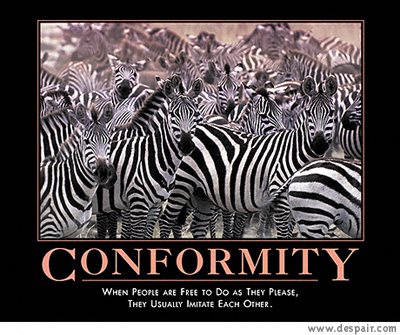
Picture credit to despair.com, a great site to go to for humor as it relates to psychology and human behavior.
Example
Most Appropriate Term
The cognitive component of group antagonism
The affective component of group antagonism
The behavioral component of group antagonism
What is the name of the Jane Elliott study?
“He’s hot!” What factor in attraction does this illustrate?
“I’ve never fallen in love with someone I’ve never met.” What factor in attraction does this illustrate?
“We’ve got so much in common. I feel like I’m looking at the female version of me!” What factor in attraction does this illustrate?
If someone is “not like us” and is successful, we are most likely to give him/her what kind of attribution?
A classmate asks us for help on one math problem. The next thing we realize, we are helping him/her with every problem on the homework.
A teacher treats you as though you are an idiot because of an older sibling. You start performing poorly even though you are a good student and are quite bright. What concept does this illustrate?
When running at practice, you hate sprinting. But by the end of practice, you convince yourself that it helped. What concepts does this illustrate? 2x
When a brown-haired girl who hangs out with blonde-haired girls dyes her hair blond. What concept does this illustrate?
When you run with slow people, you tend to run at a slower pace than your normal one and run at a faster pace than normal when you run with fast people. What concept does this illustrate?
You see a person on the news who is similar to you (ethnicity, age, etc.) who is accused of beating his/her child. You think, “it must have been the child’s fault.” But if it had been a person not like you, you would have thought it was the parent’s responsibility. What concept does this illustrate?
You were with a group of friends who are attending a football game. Suddenly, someone from the other team hits your team’s player out of bounds, the crowd goes wild and everyone (including you) jumps into the melee. People are doing things they normally would not. What concept does this illustrate?
When with one group of friends, Mary smokes, but when with another group of friends, she never lights up. What concept does this illustrate?
In one of your homework assignments, the teacher asked you to “write your name here.” By doing so, what concept were you following? (term with **)
The people I hang with are cool. We do all our homework, compete for the highest grades, play sudoku, listen to emo music, wear all black Hollister clothes, throw gang signs, shave half our heads, and make up strange stories about taking over the world. Everyone else is an idiot. This is an example of what?
The Zimbardo prison study dealt with the issue of the importance of and the power of ___________________.
Joe finds Cindy fascinating. She listens to similar music, has been to many of the same places, and is quite a talented guitar player. He also gets funny feelings when he is around her that he cannot explain. He is feeling ________________________________.
Talking with friends and/or loved ones about what is going on in your life—your concerns and problems. What concept does this illustrate?
Chuy hates the relationship that he is in, but convinces himself that he will not give up on something he has worked so hard for. What concept does this illustrate?
When smart people, working together in groups, make really stupid decisions because no one was questioning each other. This illustrates which concept?
A classmate is a Detroit Tigers fan. He has bragged about their recent baseball success, especially with their sweep of the A’s. You treat him poorly as a result of your not agreeing with his team of choice. You won’t let him play in any of your reindeer games because he is “not like the rest of us.” This best illustrates which concept?
Adolf is a stern, organized, harsh father who insists that his children dress a certain way, act a certain way and do not disobey him. What kind of personality will his children likely have?
I am treasurer of my club and am very important to the club. I run the finances and take care of all things related to money. I am respected in my position. This best illustrates which concept?
When I am in any class, the teacher or the substitute is the boss. I follow their instructions because they are the authority figure. This best illustrates which concept?
I would like to become like the “Plastics” in my school. They are so popular and well-liked. I use their slang, dress like them, and join the same groups as they join. This best illustrates which concept?
When Jim was a freshman at college, he missed home and felt unsure about where his life was going. He met some really cool people who gave him unconditional acceptance into their group. He stopped going to classes and began telling other people about the wonderful teachings of this group. Jim has probably been ________________________________________.
Earl regularly tells his friends that he hates “those people.” He claims that they are lazy and that they are taking over his neighborhood. Jim is experiencing what concept?
When the hippies of the 1960’s counterculture were rejecting the ways of their parents, they went off and did the same things as nearly everyone else in their group—they bathed irregularly, they smoked pot, the took LSD, and all listened to the same music as each other. They were “guilty” of which idea?
Julie and Johnny were dating for over a year until Johnny had to move away to college. They had kept the relationship going for several months into the new school year. However, Johnny kept seeing this new girl in one of his classes and was put into a study group with her for class. He could not help it, but felt very attracted to her. He then decided to break up with his girlfriend rather than cheat on her. Which factor of interpersonal attraction did he fall prey to?
“I really dislike people who are not in my culture—they bug me.” Which concept does this illustrate?
Are your districts talking about the recent Department of Education report about different rates of "punishment" among student racial groups? The data are pretty stunning (and depressing): Across the 70,000 high schools studies, about 18% of the students were black, but about 30-45% of students who were suspended one or more times (or eventually expelled) were black. The report goes into much more detail about the statistical analysis, but it looks thorough and well done.
Although it might be a sensitive discussion topic, our psychology students could think about these (depressing) findings and others like them through a social psychology lens: They could talk about how the social psychology concepts they know (e.g. in/outgroup bias, stereotyping, prejudice, confirmation bias, representativeness heuristic, etc.) might contribute to this "over-identification" of black students for suspensions and expulsions. This conversation might extend into other stereotypes about people their age: I bet most of them have been followed through a store by a clerk just because of their age or appearance.
There may also be other psychological "angles" to explore as well:
Learning: In certain classes, I felt comfortable asking students to try to explain acts of racism through classical and/or operant conditioning principles (write up of this activity: Conditioning and Racism)
Unfortunately, it's not hard to find current event examples of racial bias. We have to handle these discussions with sensitivity, but our classrooms can become one of the places young people "unpack" reactions/feelings/prejudices related to race, and maybe these discussions could be a small start to a change.
The post "Hack Your Brain to Use Cravings To Your Advantage" on the Lifehacker blog got me thinking: How many of you get students involved in using psychological principles/theories to "change" something about themselves? I know this could be thin ice and we need to be careful (including parent permissions? some kind of "IRB-like" review?) but it could be a very powerful learning experience for students.
The only activity I did with students that is similar at all is "Habits and Perspectives" : Students pick a personal habit they want to change, analyze their behavior from different psychological perspectives, and design a plan to change their behavior based on one or more of the perspectives.
Anyone else do anything similar? Good idea? Dangerous idea?
The days leading up Valentine's Day might be a good opportunity to talk about one of the only "psychological love theories" I've heard of: Sternberg's Triangular theory of Love. This summary is a good overview, I think (note: looks like the links in that citation aren't working).
I enjoyed asking my students to read the abstract of the Psychological review article and using that as a basis for a discussion about the theory and how well it "fits" their experiences AND what they learned in the social psychology chapter about attraction AND other sources of information.
Maybe students could make Valentines for the different kinds of love? Could be entertaining (and potentially dangerous ... :)
If your students are all abuzz about the superbowl ads from last night's game, you may be able to turn their conversation in a social psych. direction.
Students could analyze the ads for their potential to INFLUENCE (instead of just entertain :) Students could think about how the ads use social psych. compliance strategies (e.g. foot in the door, etc.) as well as look at the work of Cialdini. This list of research based strategies is a good place to start (I haven't read his book Influence, but I've heard great things about it!
I highly recommend listening to This American Life in general, but the most recent episode is just a terrific piece that I'd love for you all to listen to as well as your students. "Mr Daisey and the Apple Factory" is a piece in which - well, here's the overview from the TAL website:
Mike Daisey performs an excerpt that was adapted for radio from his one-man show "The Agony and the Ecstasy of Steve Jobs." A lifelong Apple superfan, Daisey sees some photos online from the inside of a factory that makes iPhones, starts to wonder about the people working there, and flies to China to meet them.
It's a great example of cognitive dissonance, as Daisey comes to terms with how his actions impact people on the other side of the world, people he never thought about and at one point he even admits that he thought cool tech toys were made by robots. But don't let the fact that it's completely appropriate to be used as an assignment keep you from listening to it just for your own increased mindfulness. I would love to hear your thoughts in the comments below!
First, this official release information from Scott Plous:
Dear Colleagues,
I'm writing to invite you to apply for this year's Social Psychology Network award honoring excellence in "action teaching" -- that is, teaching which not only leads to a better understanding of human behavior but to a more compassionate, sustainable, and peaceful world.
The award is open to all instructors regardless of student level (K-12, high school, college, graduate level, or adult learners). Entries may include a student assignment, classroom activity, field experience, or web-based demonstration. For further details, please visit: http://www.ActionTeaching.org
The application process is simple, and the prize is $1,000. If you teach in a creative, socially engaged way, please consider applying for this award!
Best wishes for 2012, Scott Plous Professor of Psychology, SPN Executive Director
Second, please note the deadline is deadline: January 15, 2012 - only two weeks from today!
Third, I was able to hear Scott Plous (professor of social psychology, Wesleyan University) talk this past summer at the APA/Clark University workshop about action teaching, and he did a convincing presentation on teaching as not only a way to share information and build skills, but also to have students engage in using what they know in the real world. If you visit the Action Teaching site, you'll see some great examples of how past award winners and runners up have used action teaching in their classrooms.
I was just reading my email from Teaching Tolerance, an offshoot of The Southern Poverty Law Center trying to raise awareness of racial/ethnic issues and decreasing the conflict related to them. In the newsletter there was a link to a PBS site called "Race: The Power of an Illusion, a video from 2003." The main activity I was directed to was to look at pictures and sort the faces into racial categories. Wow.
Let's just say I was not successful. Nor are most people. It's a real eye-opening activity that can be done by a person on under five minutes and could be a great beginner to a social psychology unit or a mini-unit on race, ethnicity and/or prejudice/discrimination. Great for sociology as well.
After having watched the Zimbardo Discovering Psychology series multiple times every year since about 1990, I have wanted more from social psychology in terms of examples and current and relevant research to support concepts within the topic. The author, Sam Sommers does so with humor, both pointed and self-deprecating.
I also have a colleague who is very much in the "free will" camp philosophically and I have a difficult time convincing him about the social forces that shape our behavior. If you are like me then you will love this new book I had the opportunity to review recently. It is called, Situations Matter: Understanding How Context Transforms Your World. It will be released at the end of the year. Short review: if you like social psychology you will like this book and it's a worthwhile read.
For years I have struggled with coming up with great examples and additional research that had not been dealt with by the introductory texts. Now I have that book I've been looking for. Some highlights and observations from my dog-eared copy:
judging people's expertise by our own narrowly ranged knowledge base
being seduced by character is something we do when attributing explanations of behavior
using famous people in advertising testimonials--do they really use the products they are hawking?
realizing that situations are often invisible to us--we need to learn how to see them and their influence (the tools in this book can help me do this with my students)
Numerous explanations of situations and the influence of context on people's behavior ("what's wrong with these people?"
The wisdom of crowds--how real is it? when should we use/avoid it?
Asch's study, conformity and mimicry of nonverbal behavior
Who are you? An examination of self-definition that is flexible by situation and context
What we think we will do and what we do are often very different things--some research
A breakdown of the Singer-Schacter experiment--some details that are missing in the textbooks
An overview of what is commonly called "The Lake Wobegon Effect"--where everyone is above average
how we are skilled at self-deception
achievement based on what we are told about intelligence
gender differences--how much is biology and how much is society
proximity and love--how location influences who we are attracted to
how making yourself visible makes you more attractive
Much, much more
There are more examples and much more research referred to in the book. Bottom line is that it is an extremely helpful book to have for support for your social psychology unit.
If you have questions for the author, please comment below and we will do our best to get them answered.
You can find more of the author and this book at these links:
In a previous Teaching High School Psychology post I referenced Daniel Willingham's great summary of some of the implications of the stereotype threat. Yesterday, the Wall Street Journal briefly summarized new stereotype threat research that high school psych teachers and students might find useful and provocative.
I haven't been able to get at the journal article yet, but according to the WSJ summary, the researchers made up a fake learning styles inventory and categories ("convex or concave learning styles" - might be just as (in)valid as auditory, visual, and kinesthetic :) and told participants that either their learning style would likely impact performance on a working memory test or that would probably have no effect. As predicted, the more strongly a participant identified with the fake learning style, the lower their test score.
This study might be easily replicable by high school students (after following ethical guidelines and getting the permissions you need in your district, of course), and students might be VERY interested in how stereotypes may be impacting their learning!
One of my favorite things to do is share new ideas and perspectives with my students--especially ones that I do not necessarily have time to do within the formal curriculum. Since I teach on a 100-minute alternating block schedule, I have created a couple of activities that have the students go to web sites that deal with aspects of a unit, read through the sites, and answer questions. As much as anything, it exposes them to new resources that I've already checked for accuracy and appropriateness (front-loading). I also ask questions that have them consider issues that I have some personal interest in. Perhaps, at some point, they will continue asking questions themselves about obvious things within the context of their own lives.
Here is my first one for this fall for Social Psychology. If you'd like a .docx version of this document, email me at psydways AT gmail.com. I've also made one for the brain and biology unit later in the term.
Psychology: Web ExplorationNamePer
Social Psychology Edition rev. F2011
Be sure to read the instructions on each one to make sure you are doing the proper action.
Take your native IQ.This is a test about your knowledge related to Native Americans and their history.How did you do?Explain why you did as well or as poorly as you did.
#9So you are curious about brainwashing?Check out this site:
Find terms and ideas we’ve studied so far to find out what you can discover about brainwashing.Write down at least 5 things.
1.
2.
3.
4.
5.
#10This site is a blog about relationships written by an author in the UK.Choose one of the sub-articles and write down four observations/conclusions the research found about your topic.




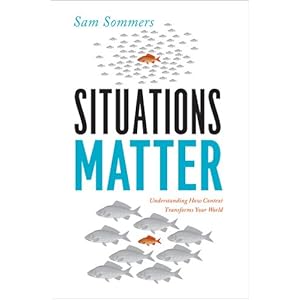
 . It will be released at the end of the year. Short review: if you like social psychology you will like this book and it's a worthwhile read.
