Showing posts with label 06 Learning. Show all posts

Friday, March 23, 2012

School Discipline, Race, and Social Psychology

Are your districts talking about the recent Department of Education report about different rates of "punishment" among student racial groups? The data are pretty stunning (and depressing): Across the 70,000 high schools studies, about 18% of the students were black, but about 30-45% of students who were suspended one or more times (or eventually expelled) were black. The report goes into much more detail about the statistical analysis, but it looks thorough and well done.

Although it might be a sensitive discussion topic, our psychology students could think about these (depressing) findings and others like them through a social psychology lens: They could talk about how the social psychology concepts they know (e.g. in/outgroup bias, stereotyping, prejudice, confirmation bias, representativeness heuristic, etc.) might contribute to this "over-identification" of black students for suspensions and expulsions. This conversation might extend into other stereotypes about people their age: I bet most of them have been followed through a store by a clerk just because of their age or appearance.

There may also be other psychological "angles" to explore as well:
  • Learning: In certain classes, I felt comfortable asking students to try to explain acts of racism through classical and/or operant conditioning principles (write up of this activity: Conditioning and Racism)
  • Developmental/Historical: The "doll" experiments of Kenneth and Mamie Clark are significant in both the history of psychology and U.S. History.

Unfortunately, it's not hard to find current event examples of racial bias. We have to handle these discussions with sensitivity, but our classrooms can become one of the places young people "unpack" reactions/feelings/prejudices related to race, and maybe these discussions could be a small start to a change.


image source: http://pulsociudadano.com/2011/12/odio-mi-piel-morena-el-racismo-visto-por-los-ninos-mexicanos/, creative commons attribution share-alike license

posted by Rob McEntarffer

Thursday, March 8, 2012

The surprising and continuing saga of Little Albert

I was fascinated and surprised a couple years ago when at team of psychological historians"solved" the long-standing mystery of the identity of Little Albert. I loved the story of their research, their exhaustive and careful examination of all the evidence they could find, and their explanation of the reasoning behind their conclusion about his identity.

Well, now I'm even more impressed: They didn't stop there! Some members of the original team kept digging into some details in the original story as told by Watson (including the detail that Little Albert was a "healthy, normal boy" when the researchers found he died a few years later of hydrocephalus.) The research team recently published their conclusion: Little Albert was likely suffering from neurological issues since birth, and that Watson purposefully misrepresented his condition when we wrote about the case.

A good example of researchers not quitting and eventually uncovering an ugly truth that casts further doubt on Watson's legacy.

photo credit: http://www2.macleans.ca/2012/02/22/bad-behaviour/

posted by Rob McEntarffer

Thursday, February 23, 2012

CRAVINGS!


The post "Hack Your Brain to Use Cravings To Your Advantage" on the Lifehacker blog got me thinking: How many of you get students involved in using psychological principles/theories to "change" something about themselves? I know this could be thin ice and we need to be careful (including parent permissions? some kind of "IRB-like" review?) but it could be a very powerful learning experience for students.

The only activity I did with students that is similar at all is "Habits and Perspectives" : Students pick a personal habit they want to change, analyze their behavior from different psychological perspectives, and design a plan to change their behavior based on one or more of the perspectives.

Anyone else do anything similar? Good idea? Dangerous idea?


posted by Rob McEntarffer

Tuesday, January 10, 2012

Tuesday, April 26, 2011

Big Bang Theory - Conditioning Penny

As fans of the Big Bang Theory TV Show (most notably my wife and oldest daughter) are no doubt aware, within the "The Gothowitz Deviation" episode (Season 3: Episode 3), there is a short segment where Sheldon tries to train Penny using Operant Conditioning.

There are a number of different versions of the clip at YouTube and other video sites. In my mind (Kent) the best version for a high school class can be found at http://blogs.cornell.edu/gp08ha1115/files/2010/04/Big-Bang-Theory-OB-21.mp4

Thursday, March 18, 2010

This is your brain on Donkey Kong (looks pretty good, actually!)


Another great post from the Mind Hacks blog, this time describing a good example of a respectful, scholarly debate between two researchers regarding the impact of video games on learning and the brain. The author of the post, Vaughn Bell, talks about being inspired by another researcher, Susan Greenfield, when he was an undergraduate. He was invited to a conference to co-speak with her about the impact of video games on learning, and he writes about the experience of admiring her AND disagreeing with her scholarly position on the topic (must have been a lively talk!). This topic might be interesting to high school students, and this is a good description of how scientists both work together through disagreeing about important topics.

Link to Vaughn's blog post about all this:
http://www.mindhacks.com/blog/2010/03/lords_ladies_and_vi.html

Thursday, October 29, 2009

Face Memory Test

The Science and Nature: Human Body and Mind portion of the BBC's website, includes a short demonstration on remembering human faces. While the primary intent behind the activity involves how the lack of sleep influences memory, the Face Memory Test would probably fit better in a Memory Unit rather than the States of Consciousness section of the class.

There are three parts to the activity each separated by a five minute break where students are shown a variety of faces and then later tested on which they can recognize. It should take between 15 to 18 minutes to complete the full activity.

The BBC website is located at http://www.bbc.co.uk/science/humanbody/sleep/tmt/

Tuesday, October 27, 2009

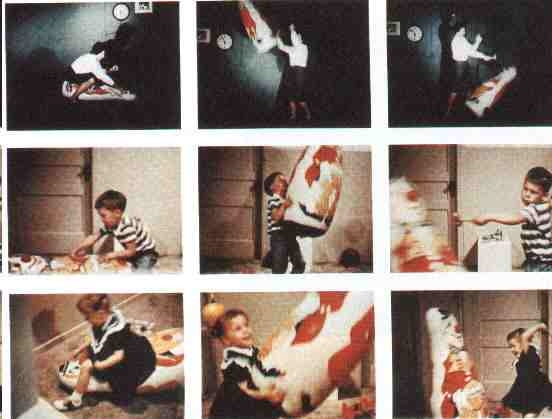
Bandura's Bobo Doll Experiment - Video

Bandura's Bobo Doll Exerpiment is both a classic in observation learning and a study high school psychology students find intriguing. While descriptions and pictures can tell much of the story, an actual video clip brings the experiment to life.

An online 5:02 minute video clip exists which includes Bandura explaining the overall experiment followed by short clips of the adult model and then the children imitating the behavior with Bandura explaining each segment.

I've included a number of links to the video as it seems to appear and then disappear from many websites. The sites which at one time included the video, now state it was removed due to copyright concerns from the Pennsylvania State University.

http://video.google.com/videoplay?docid=-4586465813762682933

http://www.youtube.com/watch?v=vdh7MngntnI

http://alevelpsychology.co.uk/psychology-videos/the-learning-approach/bandura-bobo-doll-video.html

http://www.savevid.com/video/albert-bandura-bobo-doll-experiment.html

http://s239.photobucket.com/albums/ff297/123456789ten_0666/?action=view&current=bobodoll.flv

To find the original journal article from The Journal of Abnormal and Social Psychology (1961) by Bandura, Ross and Ross go to http://psychclassics.yorku.ca/Bandura/bobo.htm

Monday, October 26, 2009

Little Albert: Found!


I haven't read the American Psychologist article about this yet, but this summary from the Mind Hacks blog summarizes the story pretty well: Dr. Hall Beck from Appalachian State University has been trying to track down the identity of "Little Albert" for 7 seven years, and he succeeded! It sounds like the article describes in detail how he used historical records, photographs, and facial recognition experts to figure out the true identity of the baby Watson and Rayner worked with all those years ago. Spoiler alert: don't read the end of the end of the blog post if you want to read the original and find out Albert's fate.

Also, Mary Cover Jones published an article years after the Little Albert study on using classical conditioning to "cure" a child of fears: A Laboratory Study of Fear: The Case of Peter.

Classical versus Operant Conditioning


Jim Biederman from the Anoka-Ramsey Community College, Cambridge and Coon Rapids, MN has developed a number of study aides for his General Psychology students helping them to sort out the the differences between classical and operant conditioning. They include a short document reviewing the types of conditioning, and two sets of examples to help students apply the information to the real world.

Classical and Operant Conditioning Study Sheet
http://www.ar.cc.mn.us/biederman/courses/p1110/conditioning.htm

Conditioning Examples Set 1 - examples and answers on the same sheet
http://www.ar.cc.mn.us/biederman/courses/p1110/examples1.htm

Conditioning Examples Set 2 - examples with answers at a linked location
http://www.ar.cc.mn.us/biederman/courses/p1110/conditioning2.htm