Showing posts with label 01 History and Approaches. Show all posts

Thursday, March 8, 2012

The surprising and continuing saga of Little Albert

I was fascinated and surprised a couple years ago when at team of psychological historians"solved" the long-standing mystery of the identity of Little Albert. I loved the story of their research, their exhaustive and careful examination of all the evidence they could find, and their explanation of the reasoning behind their conclusion about his identity.

Well, now I'm even more impressed: They didn't stop there! Some members of the original team kept digging into some details in the original story as told by Watson (including the detail that Little Albert was a "healthy, normal boy" when the researchers found he died a few years later of hydrocephalus.) The research team recently published their conclusion: Little Albert was likely suffering from neurological issues since birth, and that Watson purposefully misrepresented his condition when we wrote about the case.

A good example of researchers not quitting and eventually uncovering an ugly truth that casts further doubt on Watson's legacy.

photo credit: http://www2.macleans.ca/2012/02/22/bad-behaviour/

posted by Rob McEntarffer

Thursday, May 6, 2010

Psychology Today Blog - Head of the Class


I just discovered that the excellent Dr. Dana Dunn (long-time AP psychology exam reading Table Leader, wonderful college psych teacher, and all around great guy) writes a blog about teaching psychology for the magazine Psychology Today. The blog is called Head of the Class, and I'm just starting to dig into the archives. The current post is about grading, and Dana gets into the topic in a funny and useful way, I think. I suspect Dana would love comments from high school psych teachers (I added one!).


posted by Rob McEntarffer

Thursday, January 21, 2010

Using the Classics in the History of Psycyhology with Personality Theory

One way to cover the various personality theories is to have your students read the original writings of the classic theorists throughout history. The Classics in the History of Psychology at http://psychclassics.yorku.ca/author.htm includes many of the major theorists' writings.

We would ask that as visitors to the Teaching High School Psychology blog read through the many articles on The Classics in the History of Psychology, they would share their evaluations in the comments section.


Thursday, November 19, 2009

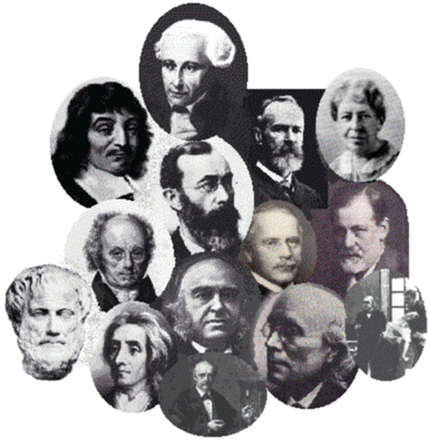
Human Intelligence Website Biography Map

The Human Intelligence website at the University of Indiana includes an interactive map of major contributors to the field of intelligence. A detailed biography is included for each individual.

To go to the "History of Influences in the Development of Intelligence Theory" map, simply click on the graphic to the right or go to http://www.indiana.edu/~intell/map.shtml

For additional information go to the home page for the Human Intelligence site at http://www.indiana.edu/~intell/

Tuesday, November 17, 2009

History of IQ Testing

IQ Tests are primarily a product of the 20th Century . While most textbooks provide a brief history, starting with Binet, a few websites do the same.

The ACE Intelligence Website at http://www.aceintelligence.com/detailed_history_of_iq.php, gives a fairly detailed history of IQ testing following various individuals important in test development including a few prior to Binet.

The IQ Test Center at http://www.iqtest-center.com/history.php provides a brief history of testing similar to many textbooks.

Classics in the History of Psychology (http://psychclassics.yorku.ca/author.htm) have a number of the original articles on intelligence testing. They include:

Baldwin, James Mark, Cattell, James McKeen, & Jastrow, Joseph. (1898). Physical and mental tests. Psychological Review, 5, 172-179.

Binet, Alfred. (1916). New methods for the diagnosis of the intellectual level of subnormals. In E. S. Kite (Trans.), The development of intelligence in children. Vineland, NJ: Publications of the Training School at Vineland. (Originally published 1905 in L'Année Psychologique, 12, 191-244.)

Cattell, James McKeen. (1890). Mental tests and measurements. Mind, 15, 373-381.

Terman, Lewis M. (1916). The uses of intelligence tests. From The measurement of intelligence (chapter 1). Boston: Houghton Mifflin.

Monday, October 26, 2009

Little Albert: Found!


I haven't read the American Psychologist article about this yet, but this summary from the Mind Hacks blog summarizes the story pretty well: Dr. Hall Beck from Appalachian State University has been trying to track down the identity of "Little Albert" for 7 seven years, and he succeeded! It sounds like the article describes in detail how he used historical records, photographs, and facial recognition experts to figure out the true identity of the baby Watson and Rayner worked with all those years ago. Spoiler alert: don't read the end of the end of the blog post if you want to read the original and find out Albert's fate.

Also, Mary Cover Jones published an article years after the Little Albert study on using classical conditioning to "cure" a child of fears: A Laboratory Study of Fear: The Case of Peter.