Showing posts with label 03 Biological Bases of Behavior. Show all posts

Wednesday, March 28, 2012

The Scientific American Day in the Life of Your Brain


I was going through my books today and rediscovered a wonderful reference for class.  It's called The Scientific American Day in the Life of Your Brain.  It takes a person from 5 am and waking up, what brain chemicals are activating us and other sensory issues.  It goes on to deal with coming to consciousness, morning emotions, directions to work, facing others, performance at work/stress, decision making, the hungry brain, the tired brain, boredom, pain, exercise, the dimming of the day, getting home from work, music, humor, love and lust, getting to sleep, falling to sleep, sleeping and problems, and people who have to work at night.  The book is at a reading level appropriate for those of use brushing up on brain science as well as high school students.

In short, take any person on any day and the book will have a section on what is happening in a person's brain.  I can imagine a creative teacher, with proper resources, making this a class assignment--what is going on with the brain and rest of the biology of humans during each part of the day, and dividing it up like the chapters/sections of this book.  If you do that, just keep this book hidden ;)


posted by Chuck Schallhorn

Thursday, March 22, 2012

Academic "Fights"

Two neuroscientists wrote an extensive review of Jonah Lehrer's new book Imagine. The comments section under the review is a fascinating example of how scholars "fight".

The reviewers point out some serious concerns in their review, for example:
"He is at his best when putting his considerable talents to the task of telling a story that is true according to the facts as we know them, rather than telling a story people want to hear."
Students could critically examine how well they support these criticisms (what evidence do they provide? How do they "prove" their criticism?)

Then students could look at Lehrer's response to the critics. He starts his response with the polite phrase "Thanks for the thoughtful and critical review" and then goes on to try to answer each critique. Students could examine this "debate" and decide which evidence is most important, etc. Later in the responses, the two critics respond to the responses.

I worry sometimes that the argumentative tone of the national debate on science topics (e.g. climate change, etc.) sounds like matters of opinion and bias. Cognitively productive, scientific "arguments" like this one are great examples about how disagreements in science can be PRODUCTIVE. The history of science is full of debates like this one, and without these disagreements, science wouldn't progress!

I'd love to hear your thoughts: does anyone help students work through "scientific disagreements" like this one?


posted by Rob McEntarffer

Friday, March 16, 2012

The Basal Ganglia and Habits

This post comes from Delancy Place, a daily email that takes extended quotes from a variety of sources to illustrate fascinating ideas.  Today's excerpt comes from the new book, The Power of Habit, by Charles Duhigg.  I just started reading my own copy of the book and it looks excellent for understanding not only habits, but for how it gathers disparate research.


In today's excerpt - when a habit is formed, that activity is governed by your basal ganglia cells, in a region completely separate from the primary cognitive areas of your brain. That's why you can brush your teeth or give someone your phone number without giving it the slightest thought, and while thinking intensely about something completely different: 

"The process in which the brain converts a sequence of actions into an automatic routine is known as 'chunking,' and it's at the root of how habits form. There are dozens - if not hundreds - of behavioral chunks that we rely on every day. Some are simple: You automatically put toothpaste on your toothbrush before sticking it in your mouth. Some, such as getting dressed or making the kids' lunch, are a little more complex.

"Others are so complicated that it's remarkable a small bit of tis­sue that evolved millions of years ago can turn them into habits at all. Take the act of backing your car out of the driveway. When you first learned to drive, the driveway required a major dose of concen­tration, and for good reason: It involves opening the garage, unlock­ing the car door, adjusting the seat, inserting the key in the ignition, turning it clockwise, moving the rearview and side mirrors and checking for obstacles, putting your foot on the brake, moving the gearshift into reverse, removing your foot from the brake, mentally estimating the distance between the garage and the street while keeping the wheels aligned and monitoring for oncoming traffic, calculating how reflected images in the mirrors translate into actual distances between the bumper, the garbage cans, and the hedges, all while applying slight pressure to the gas pedal and brake, and, most likely, telling your passenger to please stop fiddling with the radio. Nowadays, however, you do all of that every time you pull onto the street with hardly any thought. The routine occurs by habit.

"Millions of people perform this intricate ballet every morning, unthinkingly, because as soon as we pull out the car keys, our basal ganglia kicks in, identifying the habit we've stored in our brains re­lated to backing an automobile into the street. Once that habit starts unfolding, our [primary] gray matter is free to quiet itself or chase other thoughts, which is why we have enough mental capacity to realize that Jimmy forgot his lunchbox inside.
Habits, scientists say, emerge because the brain is constantly look­ing for ways to save effort. Left to its own devices, the brain will try to make almost any routine into a habit, because habits allow our minds to ramp down more often. This effort-saving instinct is a huge advan­tage. An efficient brain requires less room, [and] ... also allows us to stop thinking constantly about basic behaviors so we can devote mental energy to inventing ... video games....

"This process within our brains is a three-step loop. First, there is a cue, a trigger that tells your brain to go into automatic mode and which habit to use. Then there is the routine, which can be physical or mental or emotional. Finally, there is a reward, which helps your brain figure out if this particular loop is worth remembering for the future. Over time, this loop-cue, routine, reward; cue, routine, reward-becomes more and more automatic. The cue and reward become intertwined until a powerful sense of anticipation and crav­ing emerges. Eventually a habit is born.
   
"Habits aren't destiny. [They] can be ignored, changed, or replaced. But the reason the discovery of the habit loop is so important is that it reveals a basic truth: When a habit emerges, the brain stops fully participating in decision mak­ing. It stops working so hard, or diverts focus to other tasks. So un­less you deliberately fight a habit - unless you find new routines - the pattern will unfold automatically. However, simply understanding how habits work - learning the structure of the habit loop - makes them easier to control. Once you break a habit into its components, you can fiddle with the gears."

Author: Charles Duhigg  
Title: The Power of Habit
Publisher: Random House
Date: Copyright 2012 by Charles Duhigg
Pages: 17-20


You can get the book from Amazon.com here


posted by Chuck Schallhorn

Friday, February 24, 2012

Choose Your Own Adventure - Your Brain!


The incredible Allison Shaver (@allisonshaver), psych teacher extraordinaire in MA, and Greg Kulowiec (@gregkulowiec) posted this incredible, creative, engaging use of Youtube. I fondly remember the Choose Your Own Adventure books, and I LOVE that current students are using that "old" format, along with the "new" power of YouTube to create this engaging way to explore the brain. Really great stuff! Congrats to Allison and her students!


posted by Rob McEntarffer

Sunday, February 19, 2012

All my occipital lobe can perceive is you, valentine

For Valentine's Day last week the students in my regular psychology class were challenged to make hearts for their sweethearts (real or imagined) that fit three criteria: they had to include a part of the brain, the unit we were studying; they had to include the function of that part; and they had to fit the style of normal valentines. I'm posting some of my favorites here. What do you think? Which one do you love? And how do you tie holidays into your classes?


--posted by Steve

Thursday, February 16, 2012

New Neuroscience Video Resource

One of my long favorite sources for videos has been Learner.org, a site by the Annenberg Foundation that allows registered users to stream a variety of videos from a diverse set of topics.  I posted this blog back in 2009 to highlight some previous episodes available--I am reposting below.

Annenberg Media has a new offering for psychology teachers in 2012--a video course in the history of and how to better understand neuroscience called, "Neuroscience and the Classroom: Making Connections."  While I obviously love the "making connections" pun, I am looking forward to updating my knowledge of the brain and behavioral neuroscience.  Based solely on the descriptions, they appear to be very interesting.  The few I've watched are relatively dry, but extremely good for those of us learning or reviewing some basic content.  They seem to be much shorter and helpful for teachers--only some are for high school students--preview and see if you can use them.  The videos also contain closed captioning.

If neuroscience is a challenge for you, this site is a must!
Direct Link to the Video Series

===========================================================

From Annenberg Media
Discovering Psychology: Updated Edition

The World of Abnormal Psychology (caution, this used 1992 DSM-III diagnoses)

The Mind: Teaching Modules

The Brain: Teaching Modules

Seasons of Life (development)

Growing Old in a New Age
Death: A Personal Understanding


From PBS

Dying to Be Thinhttp://www.pbs.org/wgbh/nova/thin/program_t.html

Life's Greatest Miracle
http://www.pbs.org/wgbh/nova/thin/program_t.html

Ape Genius
http://www.pbs.org/wgbh/nova/apegenius/program.html

PBS Frontline Viewing Portal--for all showshttp://www.pbs.org/wgbh/pages/frontline/view/

Inside the Teenage Brainhttp://www.pbs.org/wgbh/pages/frontline/shows/teenbrain/view/

The Merchants of Cool
http://www.pbs.org/wgbh/pages/frontline/shows/cool/view/

American Experience--Jonestown and others
http://www.pbs.org/wgbh/americanexperience/onlineFilms/theme/popculture/


posted by Chuck Schallhorn
Sunday, January 29, 2012

Big Think and Psychology Resources

For some time now, I have been receiving regular emails from a web site called "Big Think."  While the site contains content ranging from economics, technology, style, culture, history, and more, it also contains neuroscience, psychology, and identity.

Like TED, the site contains videos from experts, but they are more individual and up-close.  These videos typically occur within longer blogs related to a variety of topics, the best of which relate to psychology and neuroscience.  I will link to some favorites below.  Because the videos are short, they can be wonderful additions to what we do in the class, to have another person (read: expert) explain an idea that we'd like to get across to our students.  Additionally, the content creates a wonderful little professional development opportunity for we teachers.

Science and Technology Link Page
Brain Bugs: Hallucinations, Forgotten Faces, and Other Cognitive Quirks (with V.S. Ramachandran)
How ADHD Affects the Brain
This is Your Brain During Orgasm
Your Storytelling Brain (with Michael Gazzaniga)


There are so many other stories and content that are fascinating, I recommend taking some time to explore.  It is well worth it.


posted by Chuck Schallhorn

Saturday, January 7, 2012

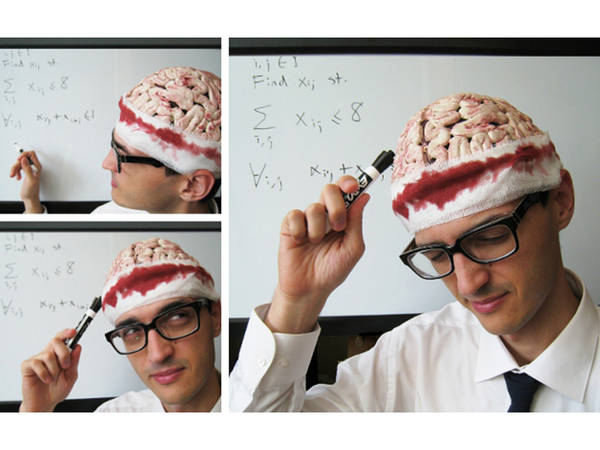
Make your own gory brain cap

I'm not the artsy-craftsy type, but I suspect some of you (or your students) might be, so I'm sharing this as found on BoingBoing. The details on how to make your own cap can be found at Make Projects. Maybe this is the hat to wearing when your class is doing the zombie brain activity?


--posted by Steve

Friday, December 23, 2011

Design a Brain Experiment Competition

The Dana Foundation is sponsoring this competition which asks high school students to design "an original brain-related experiment." Please note the quick deadline - January 19! The guidelines referred to are in PDF format and can be found here:

Design a Brain Experiment guidelines

--posted by Steve

Tuesday, December 13, 2011

More than Mouse Party

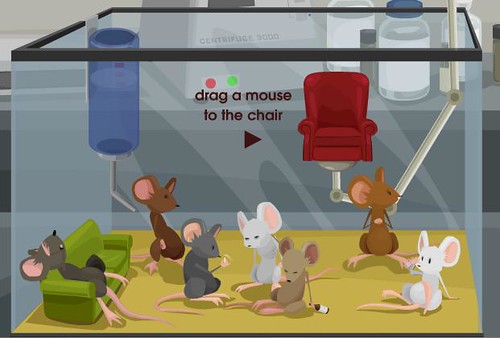
It's not that Mouse Party isn't one of the most amazing websites for teaching about how various drugs affect neural tranmission - CAUSE IT IS - but there's a lot more to this site than just Mouse Party. Check out some other offerings from the Genetic Science Learning Center at the University of Utah:

Oh - did I mention the lesson plans and activities? Oh my!

So - how do you use Mouse Party and these other sites in your class? Have you played Cerebral Commando or used any of these other links? Please share below!

P.S. I could listen to the Mouse Party music all day. Is that wrong?
-- posted by Steve

Sunday, November 27, 2011

ADD/ADHD

I was catching up on some reading this weekend and discovered a nice little article in the California Educator, our state (California Teachers Association/NEA magazine).  The post has a number of items that teachers/educators should know about ADD. 
This is the link to the direct article (digital version).
Text version of the article
California Teachers Association

Among the key ideas are:
  • this is a brain disorder--it's not that the students are trying to be annoying
  • larger class sizes make for more challenging circumstances for teachers
  • ADD/ADHD is the most common behavior disorder among children
  • self-regulation is a key deficit
  • these kids need "wiggle time"
  • article also covers teaching strategies, medication, and what life is like for someone who has the diagnosis
 Medline Plus reference and links on ADD
To learn more about ADD/ADHD, please visit the Children and Adults with Attention-Deficit/Hyperactivity Disorder website at www.chadd.org or the Centers for Disease Control and Prevention at www.cdc.gov/ncbddd/adhd.


posted by Chuck Schallhorn

Friday, November 18, 2011

Great student-created neural transmission video

Scott Miller sent me this link for a great student authored video about neural transmission (thanks Scott!). The video goes "deeper" into the chemical details of depolarization that I usually did, but it's well done! Congrats students!


posted by Rob McEntarffer

Tuesday, November 15, 2011

Psych Songs!


Our topic in psychology club this morning was "Brains!" One of our great club members asked me if I'd heard "Phineas Gage: A Song" on youtube and I said "No, but I need to!" As far as I can tell, the song is not only catchy, it's pretty accurate! (although I never heard the detail about a tea cup full of brains?)

The song reminds me of the only other direct psych-concept to song translation: "John Lee Supertaster" by one of my favorite bands, They Might be Giants (that youtube clip isn't a great version of the song - the lyrics might be more useful)

Does anyone know any other "direct" connections between songs and psych concepts? Please chime in in the comments!

(PS: If you have kids, I think the They Might be Giants kids albums are a must-have. Great music that are perfect for little ears. The science album is my favorite :)


Picture credit: http://cheezburger.com/HockeyRaven/lolz/View/293971712

posted by Rob McEntarffer

Monday, November 7, 2011

History of the Brain: A New BBC Radio Series

Do you like British accents?  Do you like learning about the brain?  How about history?  If so, I've found something you will probably like.  I was reading a blog over at "Advances in the History of Psychology" and they have a post about a new BBC Radio 4 show about the history of the brainCheck out their post here.

The BBC 4 Radio Site
Episode 1--A Hole in the Head

If you explore the site, there are also other links to some great brain education items.

posted by Chuck Schallhorn

Wednesday, October 19, 2011

Research invitation from David Eagleman


We've posted about David Eagleman before(and here). He's a skilled neuroscience writer/researcher who has a knack for finding fascinating consciousness issues and writing/talking about them in compelling and understandable ways.

He posted an invitation on Twitter this morning: "Do you hate the sound of certain words? This may be a form of synesthesia. Pls participate in our 5 min survey: words.eaglemanlab.net"

I haven't followed the link through to the research yet (I'll have to do it at home) but if any of you out there have time to take the test, please comment about your experiences here! Might be an opportunity to get students involved in research in an easy and engaging way?

posted by Rob McEntarffer

Friday, September 23, 2011

Reconstructing Visual Perception using fMRIs - Wowza!


I'm still trying to wrap my head around this research, but ... WOWZA!

(Note: Follow any of the links on this page in order to see videos of this in action)

Researchers from University of California, Berkeley used fMRI scans to "reverse engineer" images of how the brain might put together visual stimuli. Below is their "simple outline" of the study (taken from their summary on the Gallant Lab web page).

"The goal of the experiment was to design a process for decoding dynamic natural visual experiences from human visual cortex. More specifically, we sought to use brain activity measurements to reconstruct natural movies seen by an observer. First, we used functional magnetic resonance imaging (fMRI) to measure brain activity in visual cortex as a person looked at several hours of movies. We then used these data to develop computational models that could predict the pattern of brain activity that would be elicited by any arbitrary movies (i.e., movies that were not in the initial set used to build the model). Next, we used fMRI to measure brain activity elicited by a second set of movies that were completely distinct from the first set. Finally, we used the computational models to process the elicited brain activity, in order to reconstruct the movies in the second set of movies"

It's a tricky one to understand - I think the summary on the Gizmodo blog is a bit more clear, and this summary article in a Berkeley newsletter includes quotes that might help.

Here's how I think I'd summarize it for students (and there is a STRONG chance I might be wrong here, so please correct me in the comments!): Participants spent time (a long time!) in an fMRI watching movie trailers, and the researchers used that data to create a model of what their brains were doing while watching the movies. Then they collected a LOT of random youtube clips and transformed them into data ("voxels") the computers could compare with the fMRI data they stored from the participants. The computers picked the youtube clips that best matched the fMRI data, and smooshed all those video clips into a composite video. When we watch the composite video, we can see the similarities to the original clips the fMRI participants watched (although there is a high chance of confirmation bias here, right?)

Please holler in the comments about this if you have time - I'd love to know if I'm understanding this correctly!


posted by Rob McEntarffer

Sunday, September 18, 2011

Infant Brains and Teenage Brains--Two New Articles

This weekend has been a boon for neuroscience articles.  Below are a couple of articles that we could use in our classes related to development and the human brain.

1)  National Geographic--The Teenage Brain
Printable version of the article
The article begins by asking rhetorical questions about our teens and their decision making process.  The article also deals with a cross-cultural/historical mention of adolescence and its tempering effect on behavior.  The article includes an excellent overview of brain development, including myelination.  Very nice article--but what else would one expect from National Geographic.


2)  The second article comes from NPR--the article describes a book and interview with the authors of Welcome to Your Child's Brain with an article entitled "How to Help Your Child's Brain Grow Up Strong."


The NPR article also discusses brain development, but highlights what infants are capable of which is considerably more than previously thought.  Help a child develop self-control is a highlight of both the book and article. It's another good read.  Also, in the left column of the article are links to other brain books and authors.


posted by Chuck Schallhorn

Wednesday, September 14, 2011

PBS Nova Science Now "How Does the Brain Work?"


Tonight my family watched Nova Science Now "How Does the Brain Work?" What an amazing program! It covers a lot of ground - how magicians use attention, how Transcranial Magnetic Stimulation can impact judgment, how emergencies alter time perception, and artificial intelligence. Great "guest stars" too - Penn and Teller, Mo Rocca, and David Eagleman. If there is any way to get a copy to show in your classroom, you'll find dozens of short sections to show to go along with the Biopsych chapter. Great stuff.


posted by Rob McEntarffer

Tuesday, September 13, 2011

Brain Pickings


Michael Sandler sent me an email about this blog a LONG time ago (thanks Michael!) and it looks like a good resource. This post reviews an intriguing book - The Mind - a collection of essays on the brain and consciousness edited by John Brockman. I haven't purchased the book yet but the list of authors is impressive: Pinker, Seligman, Gopnik, Haidt, Zimbardo, and Ramachandran! Looks great, and this blog might be another source for good psych stuff!

Brain Pickings


posted by Rob McEntarffer

Tuesday, September 6, 2011

CNS/TBI Neuroskills Newsletter

One of the great things about the internet is the wonderful resources one can find to assist in virtually any aspect of life and adjustments one may be confronted with.  For a few years now, I've been receiving a newsletter put out by a company called Centre for Neuroskills that assists people with traumatic brain injury (TBI).  In addition to patient and family services, they also provide some excellent resources.

Below  is a partial listing from their newsletter:
Brain Injury Information
One external link is to the Centers for Disease Control (CDC) website about TBI


Following CNS on social media:
Keep up to date with daily breaking TBI research and news, as well as CNS services, products, employment opportunities and educational videos.


posted by Chuck Schallhorn